Friday, December 28, 2012
Thoughts on Commuted Sentences
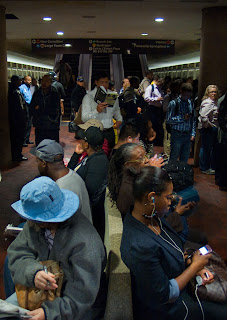
Here there is no predicted placement, you are there and it happens. There are elements that reveal themselves as parts of the story and it may be that there are times of directed seeing, but even then not much will be under control. The light is whatever is present, arrangement is by eye and body and reflex. "I must have that" must coordinate to press the shutter and the shutter must be coordinated with an understanding of the camera in hand. I accept that I see more than catch, what is caught is caught by
a moment of grace.
Tuesday, September 25, 2012
Commuted Sentences, In Passing
"What's on your mind?" An opportunity to post on Facebook phrase that leads off your Facebook page. This got me thinking as to what was on my mind, visually, and so I started to assemble pictures I took on my way back and forth to work, commuting. My day job is studio photography, an excercise in obssesive placement of objects, lights, reflectors, gobos, fishing line, mirrors, and cameras. Then the post processing obcessions, layering, darkening, lightening, touching up, spotting. It's high res cameras, exspensive lenses, expensive lighting equipment, and patience . Commuted Sentences and In Passing are two projects that have only the camera and obcessive post processing in common. A simple and maddeningly finicky Canon G5 camera and whatever passes across my mind relative to commuting replaces the studio. It is an excercise in lack of control, I see what I want, but Idon't always get it. When I get something the sentences come from what friend calls "flypaper memory" , that and Wikipedia research. Enough words, some pictures.....
Monday, September 24, 2012
Thursday, September 6, 2012
Oscar Jordan Finlay Color FDR portrait
At the risk of repeating myself, a common affliction, or affectation, perhaps, I offer this restoration of an early color process. While I was working at the National Archives Photo Unit, the Office of
Presidential Libraries came across a collection of Finlay Color transparencies and negatives. Finlay Color was an additive color process using a glass red, green, blue, color dot "taking" screen loaded in a special holder with a black and white glass negative. The resulting negative contained a dot pattern of densities corresponding to the color pattern. A glass positive was made and then aligned to a glass color "viewing" screen when the two were in alignment a color positive image could be seen and the two were bound together. The Presidential Libraries collection had several bound positives, but also a collection of unbound negatives.In addition there were a few "taking" and "viewing" screens Ektachromes of the bound positives were made as well as film positives of the black and white negatives. With the cooperation of the Smithsonian Institution's Office of Printing and Photographic Services I brought the film positives and the viewing screen to the Photographic Services lab at the Museum of American History. There I aligned the film positive with the viewing screen and photographed the resulting positive on 8X10 Ektachrome film using a process camera and lightbox. This portrait of President Franklin Roosevelt was one of those images. Oh and by the way, the Smithsonian offered me a job.
Sunday, September 2, 2012
Digital Conversions with Prosumer Camera
More digital conversions from slides, this time using a prosumer Nikon dD90 with the Bowens Illumitrans. I'm liking the results.
Tuesday, August 14, 2012
Yggdrasil From the Train
What's the best camera? The one you have with you. Thanks to C.S. Lewis, J.R.R. Tolkien, et. al. for helping me see such a thing as this. With the camera, an eye, behind the eye,a thought. Skill is good, but you must be there, wherever there is.
Wednesday, November 30, 2011
Detrained and waiting,King Street
Wednesday, November 23, 2011
Cell Phone Confessions
Carry a camera, any camera.
Thursday, May 26, 2011
Panic Shot

I got a rush call for this photo of the "Jupiter" locomotive on display at the Smithsonian Museum of American History. I had already photographed the train, but unfortunately it was on a hard drive that suddenly died (I know, "back up, back up, back up). Fortunately,as it was a test, it was one of the few files that had not been backed up to our servers. Anyway now the shot is needed
ASAP. Time and tech have moved forward, so now the shot can be done easily. Using a remote trigger on a Canon 5d MKII and a wireless flash trigger in the camera's hot shoe, I shot a test with a 580EX flash on manual full power, found my exposure, and walked around the train firing the camera and flash remotely. Total shot time, 10 minutes, number of exposures, 26, total assembly time in Photoshop, 1 hour 30 minutes. Tech specs: Canon 5d MKII, 24-70/2.8 lens, 1/30 sec f8 @ISO 400.
Subscribe to:
Posts (Atom)


